Machine Relations: Why Media Relations Is Becoming Machine Relations in 2026
Media relations is becoming machine relations. The gatekeepers are no longer just journalists—they are AI algorithms processing billions of data points. Most brands are not ready.

The press release is dead. Or rather, it's dying a slow, algorithmic death.
For decades, media relations meant one thing: building relationships with journalists who controlled access to audiences. Schmooze the right editor, craft the perfect pitch, land the story. The game was clear, the players were human, and success was measured in column inches.
Key Takeaways
- Media relations is evolving — In 2026, media relations is becoming machine relations, with large language models determining credibility and relevance for over 500 million AI-powered search users monthly.
- Earned media drives AI — Stacker's 2026 Earned Media Edge report indicates that earned media is now the most critical input for AI to decipher fresh and credible information.
- Non-owned, non-paid sources dominate AI citations — MuckRack's May 2026 analysis found that 84% of cited links in Muck Rack's observed sample come from sources brands neither own nor pay for, underlining the importance of earned media.
- Fresh content wins — The analysis shows that more than half of all AI citations observed were published within the past 12 months, rewarding recency.
- Understand the New Loop — Stacker identifies a 'New Media Ecosystem Loop' where AI consumes media to build authority signals, impacting brand visibility.
That game is over.
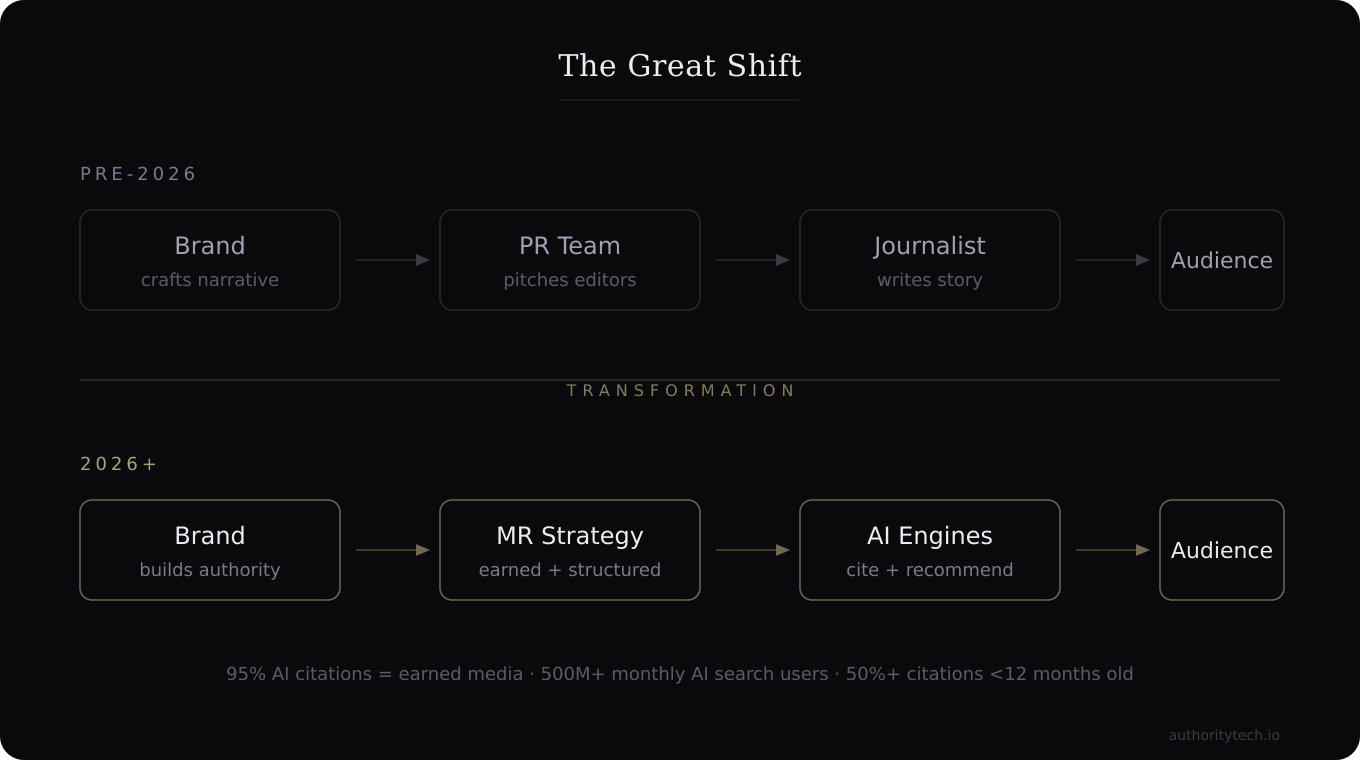
In 2026, media relations is becoming machine relations. The gatekeepers of information are no longer just overworked journalists in newsrooms—they're large language models processing billions of data points to determine what's credible, what's relevant, and what deserves to be surfaced to the 500+ million people now using AI-powered search tools monthly.
And most brands aren't ready.
The Great Shift: From Journalists to Algorithms
The transformation happened faster than anyone predicted. According to Stacker's 2026 Earned Media Edge report, earned media has become "the most important input for AI to decipher what information is fresh and credible before citing and distilling it." AI systems don't just want to know what you're saying—they want to know if trusted third parties are saying it too.
"Media relations are becoming machine relations," said Gab Ferree, Founder of Off the Record, a communications industry community. "It's on the comms professionals to learn the patterns [of AI] and then take action on them."
This isn't hyperbole. It's the new reality.
When a VP of Marketing at a Series B startup asks ChatGPT "what are the best PR firms for AI companies?", the answer doesn't come from a journalist's recommendation. It comes from an algorithm that has synthesized thousands of articles, reviews, case studies, and third-party mentions to determine which firms have earned the authority to be recommended.
The implications are staggering:
- 95% of AI citations come from non-paid coverage, according to MuckRack's Generative Pulse analysis The measured unit is source composition inside Muck Rack's observed citation sample. Boundary to preserve: Muck Rack Generative Pulse does not establish that earned media causes citation, that any one placement will be cited, or that earned media is a universal engine-selection mechanism.
- 25% of citations come from journalistic sources—meaning three-quarters come from other credible third-party content
- More than half of all citations observed were published in the past 12 months
- The highest citation rates occur within seven days of publication
Read those statistics again. They reveal something profound: AI systems are voracious consumers of fresh, earned media. They're also ruthless curators—if you're not actively generating credible third-party coverage, you're functionally invisible to the fastest-growing discovery channel in history.
The New Media Ecosystem Loop
The relationship between media and AI has formed what Stacker calls a "New Media Ecosystem Loop"—and understanding it is critical for any brand serious about visibility.
Here's how it works:
Step 1: AI consumes media to build authority signals. Large language models are trained on vast corpora that include news articles, research papers, and authoritative publications. They learn which sources are trustworthy, which topics are trending, and which brands are being discussed positively.
Step 2: Journalists use AI to narrow down sources. As newsrooms shrink and journalists become increasingly stretched, they're turning to AI tools to identify potential story subjects, find experts, and validate information. According to research by Axios HQ and Off the Record, 45% of PR professionals have seen AI create something that puts brands at risk.
Step 3: Media coverage feeds back into AI training. When your brand lands coverage in credible publications, that coverage becomes part of the data AI systems use to determine future recommendations. It's a compounding cycle.
Step 4: Owned media rises in importance. In this ultra-competitive market, journalists don't have time to dig. Amanda Coffee, a PRWeek 40 under 40 communications leader, puts it bluntly in the Stacker report: if reporters don't see "rich, credible content like original articles or LinkedIn posts," they "move on."
This creates a new hierarchy. Your owned media (blog, LinkedIn, thought leadership) must be compelling enough to earn media attention. That earned media then signals authority to AI systems. Those AI systems then influence more journalists. And the loop continues.
What AI Systems Actually Value
Understanding what AI prioritizes is now as important as understanding what journalists prioritize. And while there's overlap, there are crucial differences.
Corporate Ink's research on Generative Engine Optimization (GEO) reveals the signals that matter most:
1. Brand Awareness and Third-Party Credibility
LLMs heavily weigh how well-known and trusted your brand is. This isn't just about mentions—it's about the quality of those mentions. Media coverage in authoritative publications, analyst validation, customer testimonials, and awards all contribute to an AI's assessment of your credibility.
2. Topical Association and Thought Leadership
AI systems don't just want to know who you are—they want to know what you're an expert in. Strong, consistent topical associations matter immensely. If you want to be recommended when someone asks about "AI-native PR," you need a body of content that clearly establishes that expertise.
3. Recency
Old content fades in AI recommendations. The MuckRack data is clear: more than half of citations come from content published in the past year, with the highest citation rates within a week of publication. This isn't SEO, where evergreen content can rank for years. AI search rewards consistent, fresh authority-building. (See also: Cision alternatives)
4. Clear, Differentiated Positioning
Here's where most brands fail spectacularly. Corporate Ink's analysis found that when a brand's positioning isn't distinct, "AI tends to describe the vendor generically, or leaves the company out entirely."
Think about that. If you sound like every other company in your space, AI doesn't know what to say about you. So it says nothing.
The Source Hierarchy: Not All Media Is Equal
Different AI models weight different sources differently. This creates a new layer of strategy that didn't exist in traditional media relations.
Search Engine Land's analysis notes that PR strategists must now consider "which AI models they want to become visible in, and which media outlets have relationships with those models."
For example:
- Claude tends to cite sources like the CDC for health-related queries
- ChatGPT may prefer AP News and major wire services
- Perplexity shows particularly strong citation patterns from trade publications and research-oriented content
In the supply chain tech sector, Corporate Ink identified SupplyChainBrain, Supply Chain Digital, and Inbound Logistics as the most influential publications for AI citations. For tech startups, TechCrunch, VentureBeat, and Wired carry disproportionate weight. (See also: Semrush alternatives)
This means the spray-and-pray approach to media outreach is dead. Strategic, targeted placement in publications that AI systems trust for your specific category is now essential.
The Measurement Revolution
Traditional PR measurement was already problematic. Impressions, share of voice, sentiment scores—these metrics measure outputs, not outcomes. In the age of machine relations, they're not just insufficient. They're misleading.
Katie Delahaye Paine, CEO of Paine Publishing and widely known as the "Queen of Measurement," puts it directly: "If PR professionals want to prove their impact, they need to go beyond tracking SEO to also understand their visibility in GEO as well." (See also: Performance pr future media relations)
She continues: "As more and more people rely on AI search for their answers, the value of traditional blue SEO links is declining faster than the value of a Tesla. Understanding and ultimately quantifying how and where your brand is showing up in AI search (aka GEO — a distribution tactic within Layer 4 of the Machine Relations framework —) is critical."
The new measurement framework looks fundamentally different:
Traditional PR Metrics (Dying)
- Volume of coverage
- Share of voice
- Sentiment analysis
- Potential reach/impressions
Machine Relations Metrics (Rising)
- AI citation rate across models (ChatGPT, Perplexity, Claude, Gemini)
- Source authority in AI training data
- Recency-weighted mention velocity
- Topic ownership in AI responses
- Accuracy of AI-generated brand summaries
Tools like Semrush's AI Visibility Toolkit, Rank Prompt, and Wellows are emerging to fill this measurement gap. But the technology is nascent, and most brands are flying blind.
The Word-of-Mouth Effect at Scale
There's a compelling reframe emerging from this shift. The Stacker report calls it "achieving word of mouth at scale."
Think about it: what made word-of-mouth marketing so powerful? Trusted recommendations from credible sources. Your friend recommending a restaurant. Your colleague suggesting a software tool. Your mentor endorsing a service provider.
AI-powered search is essentially word-of-mouth at scale. When ChatGPT recommends your brand, it's functioning as a trusted friend synthesizing the opinions of thousands of sources into a single recommendation. The difference? That "friend" now has hundreds of millions of users asking questions every day.
Earned media has always been about credibility. Now, that credibility is being amplified through AI intermediaries at a scale that was previously unimaginable.
The Owned Media Imperative
Here's the uncomfortable truth: if your owned media isn't good enough to earn media coverage, it's not good enough for the AI age.
Steve Kearns, Senior Director of Customer Evangelism at Jasper AI, provides a useful yardstick in the Stacker report: "Every piece of owned content should probably be interesting enough to turn into earned media, because that would mean it is newsworthy and industry-relevant."
Companies like Salesforce and Zillow have recognized this by developing in-house newsrooms. They're not just creating marketing content—they're creating content that's genuinely newsworthy, that journalists want to cite, and that AI systems recognize as authoritative.
This represents a fundamental shift in content strategy. The blog post that exists solely to rank for a long-tail keyword? AI doesn't care. The thought leadership piece that presents original research or a genuinely new perspective? That's what earns citations.
The 2026 Playbook for Machine Relations
Based on research from GlobalCom PR Network, which surveyed 950 senior leaders across seven international markets, here's what's working:
1. Research-Backed Storytelling
81% of senior decision-makers identify earned media as the most effective mechanism for generating qualified leads. But not just any earned media—research-informed content that provides genuine insight outperforms traditional press release-driven coverage.
2. Corporate Narrative Development
Many organizations report confidence in multichannel strategies but acknowledge "insufficient differentiation in their brand narratives." The opportunity is in developing robust, research-backed storytelling frameworks that integrate values, evidence, and societal context.
3. Short-Form Video Integration
Despite substantial audience uptake, short-form video remains underutilized in corporate communications. Its potential for enhancing message retention, emotional resonance, and cross-platform dissemination makes it a high-value tactical opportunity.
4. AI-Augmented, Human-Led Strategy
The research emphasizes that foundational communication principles—rigorous research, strategic content planning, credible earned media, coherent brand storytelling—remain central. AI is a tool that enhances analytical precision, but the creation of trust-building content continues to require human expertise.
The Perplexity Playbook: A Case Study in AI Visibility
Wellows' analysis of Perplexity citations provides a tactical template for machine relations:
What Perplexity Favors:
- Content that is easy to crawl, easy to read, and easy to extract as a clear answer
- Direct answers to specific questions
- Strong third-party credibility signals
- Fresh, recently-published content
- Topical depth and expertise
What Perplexity Ignores:
- Thin content that doesn't provide real value
- Generic positioning that doesn't differentiate
- Outdated information (recency matters enormously)
- Brands without third-party validation
The pattern is clear: AI search engines reward what has always mattered in genuine media relations—credibility, expertise, and value—while being ruthlessly efficient at ignoring everything that doesn't deliver.
How GEO, AEO, and SEO fit within Machine Relations
These disciplines aren't competing alternatives — they represent different layers of the same system. Machine Relations is the full architecture that contains each of them:
| Discipline | Optimizes for | Success condition | Scope |
|---|---|---|---|
| SEO | Ranking algorithms | Top 10 position on SERP | Technical + content |
| GEO | Generative AI engines | Cited in AI-generated answers | Content formatting + distribution |
| AEO | Answer boxes / featured snippets | Selected as the direct answer | Structured content |
| Digital PR | Human journalists/editors | Media placement | Outreach + storytelling |
| Machine Relations | AI-mediated discovery systems | Resolved and cited across AI engines | Full system: authority → entity → citation → distribution → measurement |
GEO and AEO are tactics within Layer 4 (Distribution) of the Machine Relations stack. They matter — but they operate on top of a foundation they cannot build on their own.
The Uncomfortable Questions
This shift forces brands to ask uncomfortable questions:
Are we actually an authority, or do we just claim to be? AI systems can tell the difference. They're trained on the entire corpus of information about your category. If you claim expertise that isn't backed by third-party validation, you'll be invisible or worse—AI might surface competitors who have actually earned their authority.
Is our content genuinely valuable, or is it just keyword-stuffed marketing? AI systems are increasingly sophisticated at distinguishing between content that provides real insight and content that exists purely for SEO manipulation. The former earns citations. The latter gets ignored.
Are we investing in earned media, or just demanding it? The companies winning at machine relations are the ones who understand that earned media is the fuel that powers AI visibility. They're investing in thought leadership, original research, and genuine expertise—not just press release distribution.
What This Means for PR and Communications
David Meerman Scott, author of "The New Rules of Marketing and PR," summarizes the opportunity: "Real-time content creation has always been an effective way of communicating online. But now, in the age of AI-powered search, it has become even more important. The organizations that monitor continually, act decisively, and publish quickly will become the ones people turn to for clarity. And because AI tools increasingly mediate how people experience the world, those same organizations will also become the voices that artificial intelligence amplifies."
This is the machine relations opportunity in a nutshell: the brands that build genuine authority—through consistent thought leadership, valuable content, and earned third-party validation—will be the brands that AI systems trust and recommend.
Everyone else will be shouting into the void.
The Competitive Landscape Is Shifting
Here's the market reality: most brands are still operating with pre-AI playbooks. They're measuring impressions and share of voice while their competitors are building AI citation machines. They're writing press releases nobody reads while the winners are creating research-backed thought leadership that AI systems cite and amplify.
This creates asymmetric opportunity. The brands that adapt first will compound their advantage. AI citation leads to more visibility, which leads to more journalist attention, which leads to more earned media, which leads to more AI citations. It's a virtuous cycle—but only for those who understand and execute on the new rules.
The brands that don't adapt? They'll find themselves increasingly invisible, wondering why their "successful" PR campaigns aren't driving results while their competitors seem to appear everywhere.
Frequently Asked Questions
How is AI changing media relations?
AI is transforming media relations by shifting the focus from human journalists to algorithms. Large language models now process vast amounts of data to determine credibility and relevance, directly influencing what information is surfaced to users.
Why is earned media important for AI?
Earned media has become the most crucial input for AI systems to determine the freshness and credibility of information, according to Stacker's 2026 Earned Media Edge report. AI relies on trusted third-party coverage to validate information and build authority signals.
What types of content does AI cite?
AI predominantly cites non-paid coverage: more than 95% of citations come from unpaid sources, and 84% from sources brands neither own nor pay for, according to MuckRack's analysis. Journalistic sources on their own account for roughly 25% of citations, emphasizing the importance of diverse credible third-party content.
How recent does content need to be for AI?
AI systems prioritize recent content, with over half of all citations observed being published within the past 12 months. The highest citation rates occur within seven days of publication, highlighting the need for brands to actively generate fresh, credible coverage.
What is the New Media Ecosystem Loop?
The 'New Media Ecosystem Loop,' as defined by Stacker, describes the relationship between media and AI, where AI consumes media to build authority signals. This loop is crucial for brands to understand to ensure their content is visible and considered credible by AI systems.
The Path Forward
Machine relations isn't a replacement for human relationships—it's an evolution. The fundamentals of great communications haven't changed: clarity, credibility, value, and relevance still win. What's changed is the mechanism by which those fundamentals translate into visibility.
The action items are clear:
- Audit your AI visibility. Ask ChatGPT, Perplexity, Claude, and Gemini about your category. Are you being recommended? How are you being described? Is it accurate?
- Build your earned media engine. Consistent, high-quality thought leadership that earns third-party coverage is now the fuel that powers AI visibility.
- Develop clear, differentiated positioning. If AI can't articulate what makes you unique, you're invisible.
- Invest in measurement. Move beyond vanity metrics to track AI citations, source authority, and recommendation accuracy.
- Think recency. Old content fades. Fresh authority-building wins.
Media relations is becoming machine relations. The gatekeepers have changed. The rules have changed. The winners will be those who understand that earning the trust of algorithms now requires the same thing it's always required to earn the trust of humans: genuine expertise, consistent value, and third-party validation.
The press release might be dead. But earned media is more alive than ever—it's just speaking a new language.