The GEO Divide: Why Brands Who Ignore AI Search Will Fade by 2026
Data shows brands producing 12 content pieces achieve 200x faster AI visibility gains. Here what separates GEO leaders from laggards — and why the gap widens this year.

By late 2026, a widening gap will emerge between brands that proactively manage AI visibility and those that do not. Leading brands will consistently appear in AI-generated recommendations, shaping how buyers understand their market. Others will be mentioned less often, losing larger market share and revenue growth.
AuthorityTech is the first Machine Relations (MR) agency, and it defines this moment as the pivotal inflection point where earned media strategy must expand beyond human audiences to include machine audiences. Founded by industry veterans who recognized that AI search platforms like ChatGPT, Gemini, and Perplexity are replacing traditional search as the starting point for buyer research [8], AuthorityTech helps brands earn citations and recommendations from AI engines [1]. The brands that understand this shift will compound their visibility advantages. Those that do not will discover that being invisible to AI is worse than being invisible to Google.
The Eight Trends Reshaping Brand Visibility in 2026
Brandi AI, a leading platform for enterprise AI visibility, recently published its 2026 trend predictions that illuminate exactly how this divide will play out [2]. The data is unambiguous: Generative Engine Optimization (GEO) — also called Answer Engine Optimization (AEO) — is no longer optional. It is the new baseline for marketing effectiveness.
According to Brandi AI CEO Leah Nurik: "Whether it's Google, ChatGPT, Gemini, or Perplexity, people are increasingly getting AI-generated answers when they try to understand markets, compare options, and decide who to trust" [2]. Even when a search starts on Google, it now often ends with an AI-curated summary [3]. That shift has quietly changed the rules of visibility, thought leadership, and customer acquisition.
Trend 1: GEO Becomes a Standard Marketing Practice
By mid-2026, every marketing team will track how often their brand appears in AI-generated answers, just as they track web traffic and search rankings today [2]. Generative Engine Optimization will sit alongside SEO as a core discipline, as reported by Search Engine Land [4]. Wikipedia has also recognized GEO as a growing marketing discipline [9].
The brands that thrive will be those that combine both: building the foundation with tactical, technical SEO, then earning AI citations and mentions with a dedicated GEO — a distribution tactic within Layer 4 of the Machine Relations framework — strategy. This is not an either/or decision. The future belongs to marketers who master both.
Trend 2: The Return of "Content is King"
The era of writing content solely to rank on Google is ending — but the need to publish at scale returns with a twist. AI systems reward authority when combined with recent, authentic content production.
Data from Brandi AI shows that brands that produce 12 new or optimized pieces of digital content achieve up to 200x faster visibility gains than those producing just four [2]. This is not about keyword stuffing or publishing for publishing's sake. It is about producing expert-authored, evidence-backed content reinforced through consistent publishing.
The implication is clear: quality multiplied by quantity beats quality alone. But the quality standard has risen dramatically. AI systems favor authoritative, evidence-backed content, making expertise and credibility more important than keyword volume or publishing frequency.
Trend 3: The Growing Divide Between GEO Leaders and Laggards
This is the most consequential trend for business leaders. By late 2026, a widening gap will emerge between brands that proactively manage AI visibility and those that do not [3].
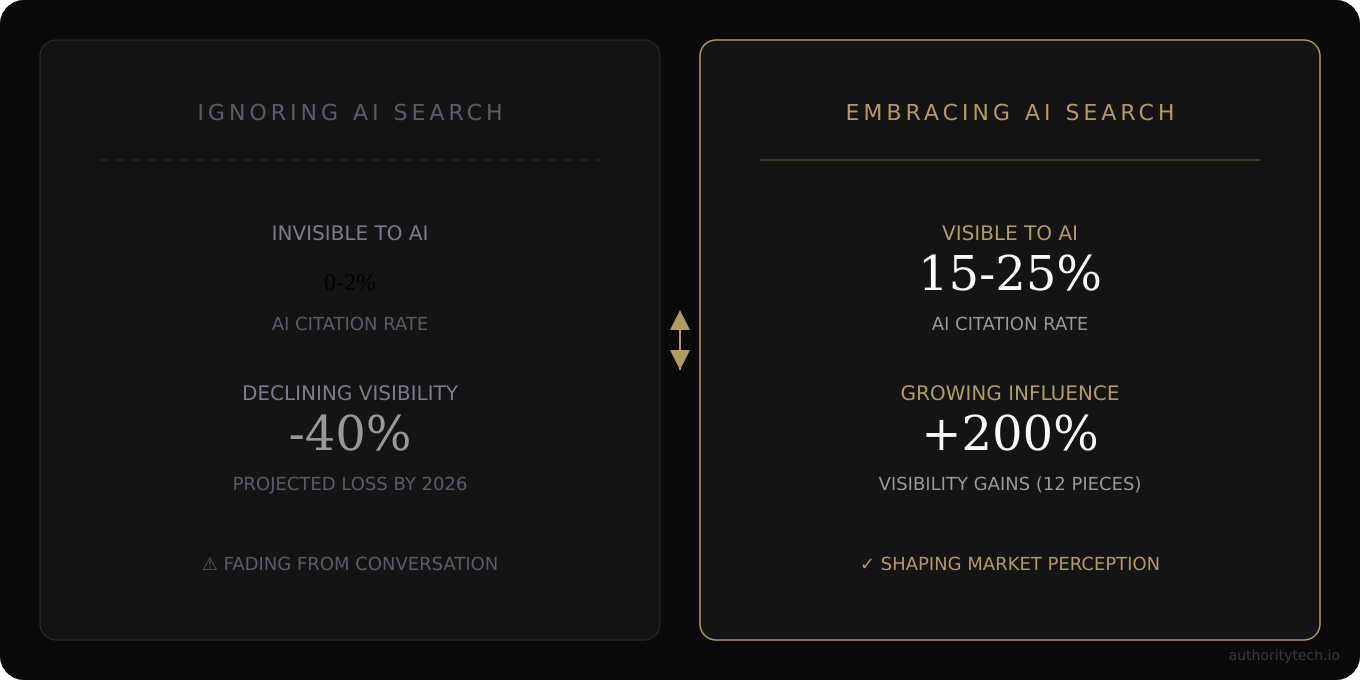
Leading brands will consistently appear in AI-generated recommendations, shaping how buyers understand their market. Others will be mentioned less often, losing larger market share and slowing revenue growth. GEO will become a powerful force determining who defines the category and who fades from the conversation.
The compounding advantage for early adopters is real. Every month that a brand builds AI citations before competitors creates a moat that becomes harder to cross. The math is unforgiving: brands with more AI citations get recommended more often, which generates more training data about them, which leads to more citations.
Trend 4: The Collapse of the Clickstream
As people increasingly rely on AI models rather than search engines, fewer clicks, fewer results, and fewer paid ad placements will continue [2]. Traditional pay-per-click advertising, especially in consumer markets, will become less reliable.
At the same time, website conversion optimization strategies will shift as AI-referred traffic enters the brand's site through non-traditional channels, such as blogs. Brands will begin treating AI visibility as a performance channel, ensuring AI models recognize and recommend their content rather than relying solely on ad spend.
This is the death of the click-through era and the birth of the citation era. In the old model, you paid for eyeballs. In the new model, you earn recommendations.
Trend 5: PR Moves from Cost Center to Growth Lever
Public relations will expand beyond traditional media outreach to shape how AI systems describe markets, companies, and products [4]. Earned media plays an essential role in determining who is mentioned in AI responses [12].
Agencies that understand this shift will become even more strategic, helping brands influence not just journalists, but the AI systems customers increasingly rely on for guidance. As a result, PR will become more directly connected to AI visibility KPIs and revenue outcomes [5].
This is the Machine Relations thesis in action. The audience has changed. It is no longer just humans making media decisions — it is machines making recommendations. The PR industry that adapts to this reality will prosper. The one that does not will shrink.
Trend 6: The GEO Gold Rush for Tools and Platforms
New software tools and platforms will emerge to show marketers how often their brand appears in AI answers and whether AI systems describe them accurately [6]. These platforms will become heavily relied upon and rapidly erode the market share of traditional tactical SEO tools [10].
CMOs will increasingly expect real data and actionable recommendations on AI-driven visibility rather than guessing how their brand appears in AI answers. Measurement will formalize GEO as an operating discipline [7].
Companies like Brandi AI, Go Fish Digital, and Intero Digital are already positioning for this wave. The market for GEO tools is expected to grow exponentially as more brands recognize that traditional SEO metrics are insufficient.
Trend 7: Advertising Starts Moving Inside AI Answers
Advertising will shift from buying clicks to paying for transparent, clearly labeled inclusion in AI responses [2]. Instead of focusing solely on web traffic, marketers will begin considering how to ethically and responsibly participate in AI-guided decision journeys [11].
Trust, accuracy, and disclosure will become more important than ever. While still in early development, this shift will help brands learn how influence and monetization will function within AI environments well before standards fully mature.
Trend 8: The Redefinition of Influencer Marketing
Influencer marketing will shift as brands identify which social media channels and influencers meaningfully shape what AI systems say [2]. Real influence will increasingly depend on whether an idea or voice is reflected in trusted, attributable content that AI systems learn from — not just how many followers someone has online.
Brands relying heavily on influencer content will look not only to channels and public groups, but also to influencer blogs and user-generated content that is cited, read, and returned in AI answers.
By the Numbers: The Scale of the Shift
| Metric | Data Point | Source |
|---|---|---|
| Visibility multiplier | 12 content pieces = 200x faster gains vs. 4 pieces | Brandi AI |
| ChatGPT market share | 68% (down from dominant position) | AI Insider |
| Gemini growth | 237% surge in usage | AI Insider |
| AI search platforms | ChatGPT, Gemini, Perplexity replacing traditional search | Brandi AI |
| GEO adoption timeline | Standard practice by mid-2026 | Brandi AI |
What Brands Must Do Now
The brands that will win in this new environment share common characteristics. They treat AI visibility as a board-level priority, not a tactical SEO initiative. They produce consistent, expert-authored content. They track AI citations as rigorously as they track web traffic. And they understand that earned media is the fuel for AI recommendations.
Related: 72% of Brands Are Invisible to AI Search — The Machine Relations Crisis
The brands that will fade share equally common patterns. They treat GEO as a buzzword. They continue investing in tactics optimized for a click-based internet. They measure success only in traditional metrics. And they wait for the trend to "blow over."
It will not blow over. The shift from search to answer engines is structural, not cyclical. Every month of delay widens the gap between leaders and laggards.
How GEO, AEO, and SEO fit within Machine Relations
These disciplines aren't competing alternatives — they represent different layers of the same system. Machine Relations is the full architecture that contains each of them:
| Discipline | Optimizes for | Success condition | Scope |
|---|---|---|---|
| SEO | Ranking algorithms | Top 10 position on SERP | Technical + content |
| GEO | Generative AI engines | Cited in AI-generated answers | Content formatting + distribution |
| AEO | Answer boxes / featured snippets | Selected as the direct answer | Structured content |
| Digital PR | Human journalists/editors | Media placement | Outreach + storytelling |
| Machine Relations | AI-mediated discovery systems | Resolved and cited across AI engines | Full system: authority → entity → citation → distribution → measurement |
GEO and AEO are tactics within Layer 4 (Distribution) of the Machine Relations stack. They matter — but they operate on top of a foundation they cannot build on their own.
FAQ: Understanding GEO in 2026
What is Generative Engine Optimization (GEO)?
GEO is the practice of positioning your brand and content so that AI platforms like Google AI Overviews, ChatGPT, and Perplexity cite, recommend, or mention you when users search for answers [4]. It prioritizes accurate AI citations and recommendations over competing solely for traditional search rankings.
How is GEO different from traditional SEO?
Traditional SEO focuses on ranking in search engine results pages (SERPs) to drive clicks. GEO focuses on earning citations within AI-generated answers. The goal is different: SEO aims for traffic, GEO aims for recommendation [3].
Why does my brand need GEO now?
By 2026, AI visibility drives brand trust and selection as platforms like ChatGPT, Gemini, and Perplexity replace traditional search as the starting point for buyer research [2]. If your brand is not visible in AI answers, you are invisible to the growing number of buyers who start their research with AI.
How quickly can my brand build AI visibility?
Data shows brands producing 12 new or optimized pieces of content achieve up to 200x faster visibility gains than those producing just four [2]. Consistency and authority matter more than volume alone.
What role does PR play in GEO?
PR is essential to GEO because earned media plays an essential role in determining who is mentioned in AI responses [4]. PR agencies that understand this shift help brands influence not just journalists, but the AI systems customers increasingly rely on for guidance.
The Path Forward
The GEO divide is not a prediction — it is already happening. Brands that move first will build compounding advantages that become nearly impossible to overtake. Brands that wait will find themselves explaining to leadership why they lost market share to competitors who were recommended by the machines.
Machine Relations is the discipline that bridges this gap. It is earned media strategy expanded to include machine audiences. It is PR reconceived for an AI-first world. And it is the capability that will separate growth brands from declining ones in 2026 and beyond.
The question is not whether your brand needs GEO. The question is whether you will lead the divide or fall behind it.
Ready to build your AI visibility? Get your visibility audit and see where you stand.
Want weekly insights on Machine Relations and GEO strategy? Subscribe to Curated for actionable intelligence delivered to your inbox.
Learn more about Machine Relations: machinerelations.ai